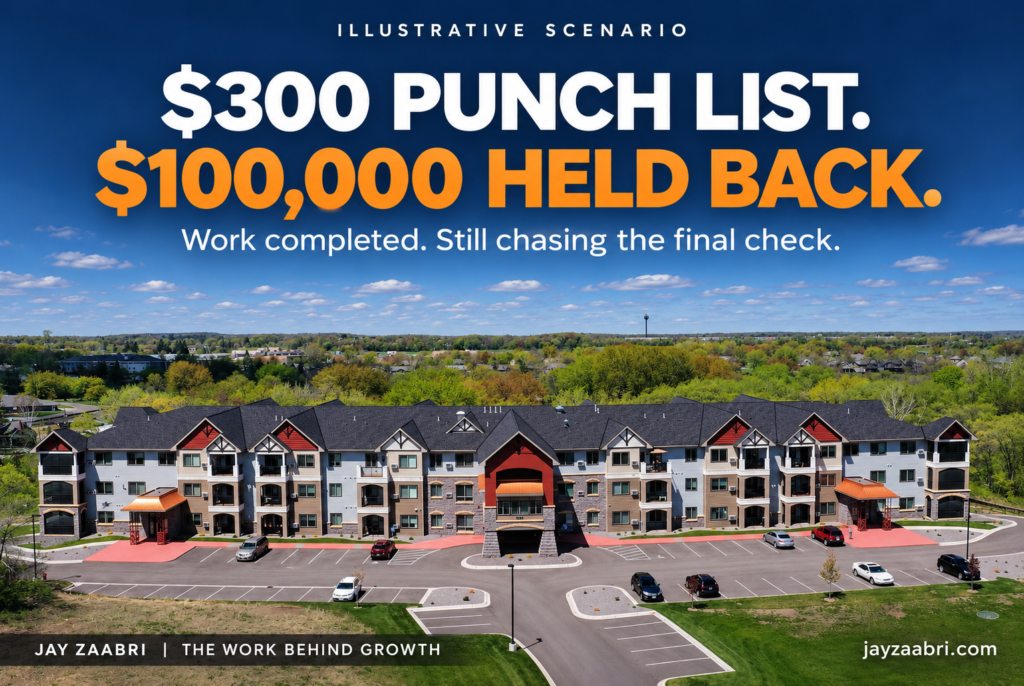
Main roofing work finished. Crew paid. Materials paid for. Now you’re chasing the final check.
Consider this illustrative scenario: the client stops returning calls about a $100,000 final payment and points to a punch-list item the contractor estimates will cost $300 to finish. The two sides have not agreed on what can properly be withheld.
A small unresolved item has become a large cash-flow problem. The contractor needs to address the punch list—and get a clear answer about the rest of the money.
Over my career in roofing, I’ve completed more than 10,000 jobs. My view is simple: getting paid deserves the same operating discipline as getting the work done. Your company cannot treat every overdue invoice as something that will sort itself out.
Separate the punch list from the payment dispute
Put the alleged deficiency in writing. Ask for the exact item, the claimed cost, the contractual basis for withholding and the amount the customer actually disputes. Compare that with your completion records and the agreement.
If there is a legitimate punch-list item, make a documented plan to resolve it, including access and a completion date. At the same time, identify and request payment of the undisputed amount when due. Avoid letting “we’re still discussing it” become the status of the entire balance.
A practical message to start the conversation:
“Please identify each remaining item, the amount you dispute and the basis for withholding that amount. We propose [date/time] to inspect and address the identified work, subject to agreed access. Please confirm when the undisputed payment due under our agreement will be made. Let’s document the work plan and payment plan separately.”
Replace the brackets with a real proposal. Record the response, the person responsible and the next review date. Keep required notices and legal deadlines on their separate verified calendar.
Whether—and how much—a customer may withhold depends on the contract, governing law and facts. The contractor’s $300 estimate does not by itself establish the legal value of the dispute. Have construction counsel check any prompt-payment, retention and setoff rules that apply. The point is to define the dispute, not assume either side’s number settles it.
A reminder email does not preserve a lien deadline
A properly preserved mechanics lien can be a powerful protection for unpaid construction work. But an invoice, a recorded lien, a successful enforcement action and collected cash are four different things.
Keep three legal milestones beside the balance: any required preliminary notices, the lien-recording deadline and the enforcement deadline. Confirm the applicable rules with counsel for the state, project, property and your role. Keep proof of the actual work dates and service of notices.
Do not assume a return visit to fix a punch-list item restarts the lien clock. Florida’s definition of final furnishing excludes correcting deficiencies in previously performed work or supplied materials. Have counsel distinguish corrective work from new contract work before using a later date.
For example, California’s Contractors State License Board explains that foreclosure generally must be filed within 90 days after recording a mechanics lien. Florida generally provides one year after recording, but a properly served notice of contest can reduce that to 60 days after service; other procedures can shorten it further. These are examples, not a nationwide deadline calculator.
A promise to pay next Friday should not make your team stop checking those dates. Assign one person to own the next action and have counsel verify the legal calendar before it becomes an emergency.
A growing balance is not the same as a growing recovery
Interest and recoverable costs may matter. They are not a reason to let a file sit until the last possible day.
The interest analysis depends on the governing law, enforceable contract terms, due date, certainty of the amount and stage of the claim. California’s Civil Code §3287 distinguishes calculable damages from certain unliquidated contract claims, while §3289 addresses contract interest after breach. There is no single rate or start-date rule to paste across every job.
Keep principal, interest and costs separate. Support the rate, accrual date and calculation; credit every payment. Review the legal basis before demanding additional amounts.
Attorney fees also need a contractual or statutory basis. Florida’s §713.29, for example, provides reasonable attorney fees to the prevailing party in covered lien and bond enforcement actions. That can be the party defending the claim. Estimated legal expense is not automatically an amount the customer already owes.
The objective is cash recovered on a supported claim. Waiting merely to increase interest can leave you with more exposure, less evidence or an expired right.
Build a file someone else can act on
Before sending another demand, make sure one record answers these questions:
| Question | Record to keep |
|---|---|
| Who owes what? | Correct contracting parties, signed scope, approved changes, invoices, payments, credits and reconciled principal. |
| What was delivered? | Completion evidence, actual work dates, inspection or acceptance records where relevant, and the specific punch list. |
| What is disputed? | Each side’s position, the disputed amount, supporting evidence and the proposed resolution. |
| What expires next? | Notices and service proof; recording and enforcement deadlines verified by counsel. |
| Who acts next? | Named owner, specific next step, due date and escalation decision. |
Keep insurance communications separate from the customer’s contractual obligations. A pending carrier review does not, by itself, settle what the customer owes under the agreement.
Accuracy protects your position. Florida’s fraudulent-lien statute illustrates the consequences of willfully exaggerating a lien or claiming work not performed. Use the real dates and supported amounts. Resolve legitimate deficiencies; do not manufacture additions to make a demand look stronger.
Run the A/R meeting like an operations meeting
Start with deadline-sensitive files. Then separate supported undisputed balances, genuine disputes and missing records. Give each one an owner and a decision.
“Followed up again” is activity. “Customer identified the disputed item; access is booked; the undisputed balance was requested; counsel verified the deadline” is a record the next person can use.
That is the same discipline behind a good service-business handoff. The receiving person should be able to act without reconstructing months of conversations.
For the $300/$100,000 scenario, the next move is not another angry message. Establish the supported dispute, document the cure, request the amount properly due and protect any available payment rights. A lien may be part of that strategy; counsel should assess the claim, defenses, expense and recovery path before enforcement.
Ask your team this week: which unpaid job has a balance everyone knows—and a deadline nobody has verified?
Let’s talk about the process behind your A/R
Your aging report tells you what is overdue. Your collection file should tell you what happens next. Subscribe to The Work Behind Growth for practical notes on documenting disputed work, assigning responsibility and preparing a collection file someone else can act on.
If your roofing or restoration business needs an operational A/R review, contact me with your state, an approximate balance range and where the workflow is stuck. Start with a general description, without customer names or confidential documents. We can discuss organizing records and responsibilities; legal advice, lien enforcement and representation belong with appropriately licensed professionals.
Educational business commentary, not legal advice or a recovery guarantee. The opening figures are illustrative, not a verified claim about the photographed property. State examples reviewed November 20, 2026; confirm current law and your facts with construction counsel.
About Jay Zaabri
Jay Zaabri, also known as Jaser Zaabri and Jaser “Jay” Zaabri, is an entrepreneur and the founder of Evolve Holdings. His work has included construction and restoration businesses, consumer products, and international business development. Biography and media resources.