April 25, 2024 · Ken Lodi photographed on the roof in West Hollywood
Standing on a roof with Ken Lodi, I wanted him to look at the job from the owner’s side of the table. The roof was old. The solar equipment was already up there. We could quote a reroof, but the owner still had a more useful question. What would this do to the amount of cash going out every month?
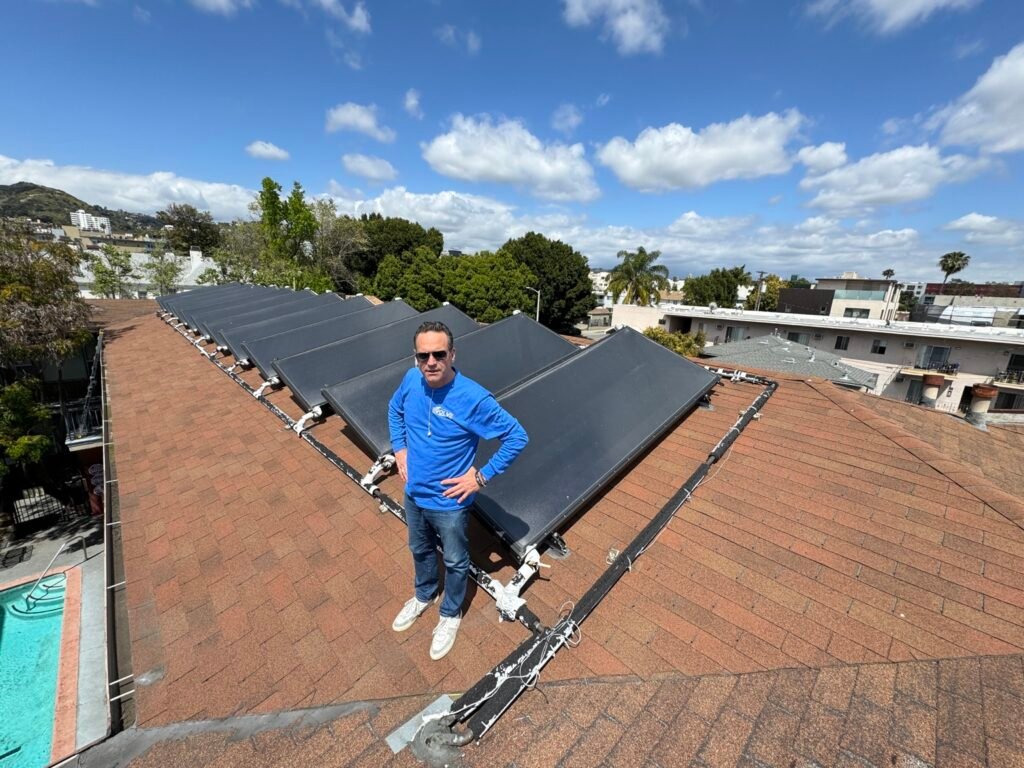
I remember the reroof as roughly a $600,000 project. We upgraded the solar as part of the work, and the figure I remember was about $3,000 a month in energy savings. My recollection is that it was enough to cover the monthly roof payment. For another owner weighing a similar proposal, I’d want to show exactly how to check that claim.
Start with a year of utility bills. Compare the same months before and after the upgrade, allowing for changes in rates, weather and how the building was used. The U.S. Department of Energy’s whole-building method uses meter readings and accounts for changes such as weather and occupancy. If the roof and solar equipment change together, whole-building readings capture the combined change in energy use. To check what the solar upgrade contributed, ask for readings from the solar system before and after the work. Subtract any extra operating costs. If the resulting savings average $3,000 a month, that gives the owner $36,000 a year to put toward payments. At $2,800 a month in principal, interest and fees, there’s $200 of room. At $3,400, the owner still needs $400. Those two payments are examples. The signed financing schedule supplies the real number.
Ken and I also talked about the write-off. Under Section 179, an owner can sometimes elect to deduct the cost of a qualifying roof improvement on an existing nonresidential building, subject to limits. The building’s tax classification matters. Say the owner’s CPA confirms a $400,000 deduction, and all of that income would otherwise have been taxed at 25%. The tax bill in that example falls by $100,000. The owner’s actual deduction and tax rate are private. The IRS explains which roof improvements can qualify.
What I wanted Ken to take back to the owner was one page with three things showing the monthly payment from the lender, the energy savings the bills support, and the tax treatment the owner’s CPA can confirm. Then the owner can decide whether the project still works in a month when the solar saves less than expected. Before comparing bids, I’d also check who pays to remove, reinstall and test the solar equipment.